
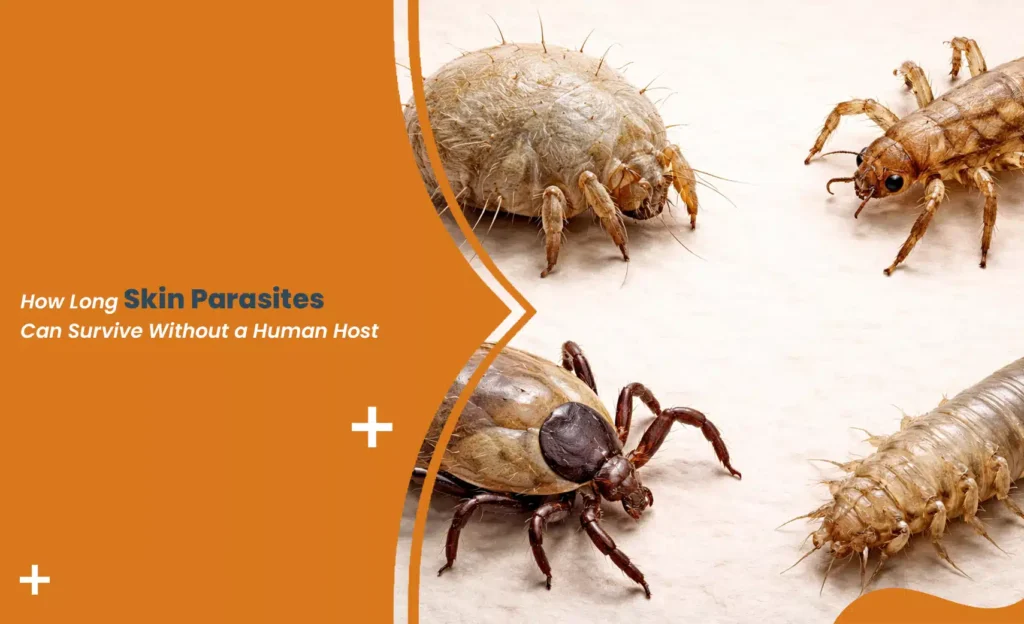
There’s something uniquely unsettling about skin parasites.
It’s not just the itching. Or the rash. Or the tiny red tracks that weren’t there yesterday.
It’s the thought that something microscopic is living on you.
And once that thought settles in, another one follows quickly:
If they leave my body… how long can they survive without me?
It’s a practical question. But it’s also emotional. Because when someone is dealing with scabies, lice, or other parasitic skin infections, they’re not just worried about treatment.
They’re worried about their couch. Their sheets. Their favorite sweater.
Are those things safe?
Let’s unpack that – calmly.
Parasites Depend on Humans More Than You Think
Most skin parasites are highly dependent on human hosts.
Take scabies mites, for example. They burrow into the top layer of skin to live and lay eggs. Their entire life cycle revolves around human contact.
When separated from a host, their survival window shrinks dramatically.
In typical indoor conditions – room temperature, normal humidity – scabies mites can survive roughly 48 to 72 hours off the human body.
That’s not long.
But it’s long enough to make people anxious.
Lice survive slightly differently. Head lice, for instance, usually die within one to two days away from the scalp because they require frequent blood meals.
Skin parasites are not built for independence.
They are biologically specialized.
Environment Changes Everything
Survival depends on environment.
Cooler temperatures can extend lifespan slightly. High heat shortens it. Low humidity reduces survival time. Moist, temperate conditions help them last longer – but not indefinitely.
Your living room isn’t a tropical rainforest.
Most parasites don’t thrive on furniture the way people imagine.
Still, certain fabrics can act as temporary holding spaces.
Which is why doctors often recommend washing bedding and clothing in hot water during treatment.
Not because parasites live there for weeks.
But because even a short survival window matters.
The Psychological Weight of “What If”
When someone is diagnosed with scabies, the first reaction is often embarrassment. The second is panic about contamination.
I once spoke with a university student who washed everything she owned twice. She avoided sitting on her own couch for days.
Her doctor reassured her: mites cannot survive long without skin contact.
Treatment was prescribed – including oral ivermectin in some cases, such as Covimectin 6mg, depending on severity and physician assessment.
But her anxiety lasted longer than the mites ever could.
Fear tends to overestimate survival time.
Biology is less dramatic.
Treatment Interrupts the Cycle
When scabies or certain parasitic skin infections are confirmed, physicians may prescribe topical therapy or oral medication.
In some cases, Covimectin 6mg is used under medical supervision to eliminate mites systemically.
Medication reduces parasite burden on the body.
Simultaneously, environmental cleaning reduces any short-term external survival risk.
Used together, they close the loop.
That dual approach – medication plus cleaning – prevents reinfestation.
But again, the timeline is short.
Most skin parasites are not capable of surviving weeks on household surfaces.
What About Mattresses and Upholstery?
Parasites cannot burrow into mattresses like horror stories suggest.
They remain on the surface.
Vacuuming upholstery and washing removable fabrics is generally sufficient.
Plastic sealing of items for weeks is usually unnecessary because the organisms simply cannot survive that long without feeding.
When patients receive treatment such as Covimectin 6mg, physicians often recommend washing clothing worn in the previous few days.
Not months.
Days.
That distinction matters.
Do All Skin Parasites Behave the Same Way?
No.
Different organisms have different survival windows.
Scabies mites: roughly 2–3 days off host.
Head lice: about 1–2 days.
Crab lice: similar short window.
Cutaneous larva migrans (hookworm larvae under the skin) do not survive long on dry surfaces at all. They require moist soil conditions.
Most human skin parasites are fragile outside the body.
Their biology isn’t designed for prolonged external survival.
It’s designed for intimacy.
Why Reinfection Still Happens
If parasites die quickly off the host, why do reinfections occur?
Because close contact spreads them before environmental death happens.
Skin-to-skin contact is the primary transmission route for scabies.
Shared bedding within that short 48-hour window can contribute.
The window is narrow – but it exists.
When oral treatment such as Covimectin 6mg is prescribed, physicians often advise treating close contacts simultaneously.
Because the human network matters more than the couch.
The Myth of “Infested Homes”
Homes don’t become permanently infested by skin parasites.
That’s a misunderstanding fueled by dramatic storytelling.
Unlike bed bugs – which are entirely different organisms – scabies mites cannot establish colonies in walls or carpets.
They need human skin.
Without it, they die.
That biological dependence is actually reassuring.
How Long Should You Clean After Treatment?
Generally, environmental cleaning focuses on items used within the previous three days.
Hot water washing. High-heat drying.
Items that cannot be washed can be sealed for several days – though in most cases, natural die-off already occurs within that time frame.
If prescribed Covimectin 6mg, follow your physician’s instructions carefully regarding timing of doses and environmental measures.
Treatment success depends more on proper dosing and simultaneous contact treatment than on extreme household sterilization.
A Personal Reflection on Contamination Anxiety
As a health writer, I’ve noticed that people often fear invisible threats more than visible ones.
Parasites trigger imagination.
You can’t see them. You can’t hear them. You just feel itching.
When someone starts treatment – whether topical therapy or oral medication like Covimectin 6mg – relief begins biologically before it begins psychologically.
The skin heals faster than the mind sometimes does.
Understanding survival timelines helps.
Short lifespan off-host means limited environmental risk.
Can Parasites Hide in Clothing Long-Term?
Not realistically.
Fabric does not sustain them long-term.
Without access to blood or skin, their metabolic processes fail quickly.
That’s why washing clothes worn in the days leading up to treatment is sufficient.
When Covimectin 6mg is used appropriately under medical supervision, and environmental cleaning is done concurrently, reinfestation risk drops dramatically.
Time works in your favor.
Final Thoughts
Skin parasites survive outside a human host for a limited time.
Hours to a few days.
Not weeks. Not months.
Their biology ties them closely to human skin.
Treatment – whether topical or oral options like Covimectin 6mg – eliminates active infestation. Basic environmental cleaning covers the short survival window off-host.
The science is calm.
The fear often isn’t.
But when you understand the timeline, the panic softens.
Parasites are dependent organisms.
Without you, they don’t last long.
And that’s the part most people find most reassuring.
FAQs
1. Do I really need to deep-clean my entire house?
Probably not. That urge to scrub everything from ceiling to floor usually comes from anxiety, not biology. Most skin parasites can’t survive more than a couple of days without human contact. Washing recently worn clothes and bedding in hot water is typically enough. You don’t need to turn your home into a biohazard zone.
2. Can I get reinfected from my mattress days later?
Highly unlikely after a few days. Parasites like scabies mites depend on human skin to survive. Without it, they die fairly quickly. Once you’ve cleaned recently used fabrics and followed your treatment plan, the risk drops dramatically. The mattress isn’t lying in wait.
3. Should I throw away clothes or pillows just to be safe?
No. Disposal is almost never necessary. Washing and drying on high heat is sufficient in most cases. Throwing items away usually stems from fear rather than medical advice. Save your wardrobe – and your money.
4. Why does it still itch even after treatment? Does that mean they’re alive?
Not necessarily. Post-treatment itching is common and can last a couple of weeks. Your immune system is still reacting to what was there. The presence of itching doesn’t automatically mean active parasites. If symptoms worsen instead of gradually improving, that’s when you follow up with your doctor.
5. How do I stop obsessing about contamination?
Information helps. Once you understand that most skin parasites survive only briefly off the body, the mental picture becomes less dramatic. Stick to practical cleaning steps, complete your prescribed treatment, and remind yourself: biology has limits. Fear doesn’t always respect those limits – but science does.