
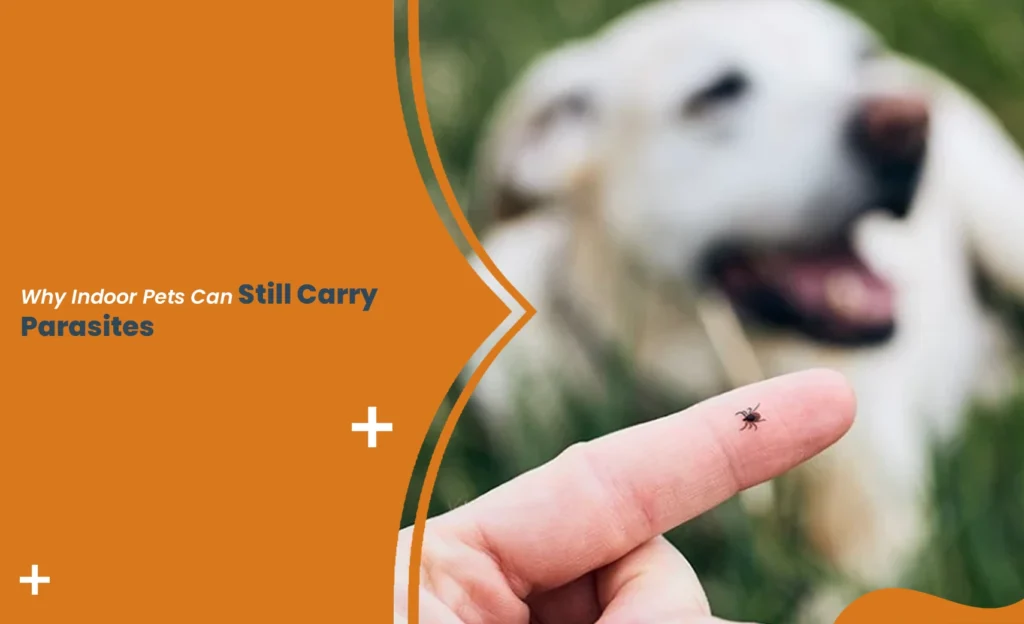
I used to think indoor pets were… safe. Like completely safe.
No dirt, no weird puddles, no street food scraps, no random animals. So where would parasites even come from, right?
But yeah, that assumption doesn’t really hold up once you look a little closer. Or honestly, once something goes wrong.
And it usually does in a very annoying, very confusing way.
So… indoor means protected? Not really
It feels like it should.
Your dog or cat stays inside. Sleeps on clean floors. Eats packaged food. Drinks filtered water. Lives a better life than most humans.
Still ends up with parasites.
It is actually quite common, but still sounds unfair to some extent.
Because “indoor” doesn’t mean isolated. Not even close.
You still open doors. You walk outside and come back in. Shoes touch floors. Hands touch everything. Groceries, bags, visitors… all of that stuff carries microscopic life.
And parasites don’t exactly need a grand entry.
Sometimes it’s just… there.
The invisible stuff we bring home
This part kind of messed with my head when I first learned it.
You step outside, walk on grass, maybe a park, maybe just pavement. That pavement has seen everything-other dogs, stray animals, rainwater runoff.
You come back home.
You don’t think twice.
But those tiny eggs or larvae? They can stick to shoes, clothes, even your skin.
And now they’re inside.
Your pet walks over the same floor. Licks paws. Grooms itself. And that’s it. That’s sometimes all it takes.
It’s not dramatic. No big moment. Just quiet transmission.
Other pets, other problems
Even in the case of pets staying indoors, exposure risk by or via other animals still remains high.
Maybe a friend brings their dog over. Maybe you visit someone with pets and then come home. Maybe your building has shared spaces.
Parasites don’t care about boundaries like we do.
They move between hosts in very simple ways. Contact, surfaces, sometimes even air particles in rare cases.
So your indoor pet ends up being part of a much bigger ecosystem without ever leaving the house.
Kind of strange to think about.
Fleas… the classic surprise
Fleas are probably the most common “wait, how?” situation.
Your pet hasn’t stepped outside in weeks. Still scratching like crazy.
Where did they come from?
They can hitchhike in. On clothes, on furniture, even through windows if there are gaps. And once they’re in, they multiply fast.
Like, really fast.
And fleas aren’t just annoying. Tapeworms are some of the other parasites, that they might carry.
So it becomes this chain reaction. Its always another thing that has been lead by the previous one.
And when the symptoms are as persistent as your children, that is when a saviour like Iverjohn 3mg comes into the picture.
Food isn’t always as clean as it looks
You’d think packaged pet food is completely safe.
Yes, mostly…most of the time.
But even when you’re resting at your home, where there is a storage or even in the manufacturing unit, contamination can occur.
Raw diets especially carry higher risks. Larvae of parasites are found in high quantity in raw and not properly cooked meat.
Also did you know that leaving your food unattended for long can signal tons of insects for a party. And for that matter, insects are not that good and clean carriers too.
So again, indoor pet, controlled environment, but still not fully sealed off.
Humans are part of the problem too
Not intentionally, obviously.
But we’re kind of the main transport system.
We go everywhere. We touch everything. Then we come home and pet our animals, sit on couches, walk around barefoot.
And pets are in constant contact with us.
So whatever we carry, even in tiny amounts, can pass on.
It’s weird because you don’t see it happening. There’s no obvious moment where you go “oh, that’s when it happened.”
It’s just… accumulation over time.
Litter boxes and indoor contamination
Cats especially.
Spreading through the dirt/litter boxes and also entry into one’s system via food, fleas or something else are ways parasites can manoeuvre their way in.
There is a constant sense of grooming that is seen among cats, hence them being very particular creatures.
So even a small contamination in the litter area can cycle back into their system.
And then back again.
It becomes a loop.
This is usually when people realize prevention matters more than just reacting later. Some end up using medications like Iverjohn 3mg as part of routine parasite control, not just treatment.
The “but my pet looks fine” phase
This one is tricky.
Because parasites don’t always show obvious symptoms right away.
Your pet might look completely normal. Eating, playing, sleeping.
Meanwhile, something is slowly building inside.
Weight changes, dull coat, occasional digestive issues-these can be subtle. Easy to ignore.
Or easy to blame on something else.
By the time it becomes obvious, it’s usually been there for a while.
Which is why preventive care, including options like Iverjohn 3mg, comes up in conversations more often than people expect.
Windows, balconies, and small openings
You might not think about this one.
There are several tiny gaps which cease to exist for passage of dust particles and even insects and rodents.
Balconies especially-birds visit, insects land, wind carries debris.
Your pet explores that area. Sniffs around. Licks surfaces.
And just like that, there’s potential exposure.
Again, nothing dramatic. No big event.
Just small, repeated contact.
Stress and immunity… yeah, that too
This part gets overlooked a lot.
There is a big role executed by the pet’s immune system even in cases of minimal exposure.
Weakening of resistance is seen through things like stress, diet changes, and even lack of exercise.
So an issue arises which didn’t exist before due to these.
Indoor pets sometimes have less stimulation, which can lead to subtle stress. It doesn’t look like stress the way it does in humans.
But it’s there.
And it affects how their body handles infections, including parasites.
Treatment vs prevention… messy decision
People usually wait.
Not always, but often.
They notice symptoms, then act.
But parasites don’t really work on a “wait and see” basis. By the time you notice, it’s already progressed.
That’s why preventive approaches exist.
Some pet owners use treatments like Iverjohn 3mg periodically, even when there’s no obvious issue.
Not everyone agrees on how often or when exactly. It varies. Vet advice matters here, obviously.
Still, the idea is simple-don’t wait for a visible problem.
Reinfection is annoyingly easy
Even if you treat once and everything seems fine…
It can come back.
Because the environment hasn’t changed much. The same exposure points still exist.
Shoes, visitors, food, surfaces.
So without ongoing care or awareness, it becomes this cycle.
Treat → improve → repeat.
Hence instead of just relying on one time solutions, continuous routines like Iverjohn 3mg should be considered.
It’s not about being careless
This is important.
There is nothing wrong in keeping an indoor pet that is affected by parasites.
It’s just… reality.
The world isn’t sterile. Ecosystems that are sealed cannot be called homes, and also keep in mind that parasites are really good at surviving and spreading amongst the environment.
Even very clean homes, very careful owners-still happens.
Hence awareness should always be on the forefront rather than just blaming others.
Little habits that kind of help (not perfectly)
Wiping paws. Cleaning floors more often. Washing hands after being outside.
These things reduce risk.
They don’t eliminate it.
And that’s okay. The goal isn’t perfection. It’s just lowering the chances a bit.
Combined with proper care and, when needed, treatments like Iverjohn 3mg, it creates a more balanced approach.
Not foolproof. Just… better.
Sometimes you only learn after the fact
Until some big thing happens, people are totally unbothered by this fact.
A vet visit. A weird symptom. Unexpected test results.
Then it clicks.
“Oh… even indoor pets?”
Yeah.
Even indoor pets.
And then you adjust. Maybe add preventive care. Maybe clean a bit more. Maybe look into options like Iverjohn 3mg for ongoing protection.
It’s a learning curve.
A slightly annoying one.
FAQs
Can indoor pets really get parasites?
Yes, through surfaces, food, or humans bringing them inside.
For indoor pets, is regular parasite treatment important?
Most often it may be recommended, but that totally depends on your vet’s advice.
In case of indoor pets, are fleas the most common ones to be found ?
Surprisingly, yes. They can enter through clothes or other animals.
Is Iverjohn 3mg safe for all pets?
Please use it with guidance only.
Will parasites go away by themselves?
Rarely. Most cases need treatment.