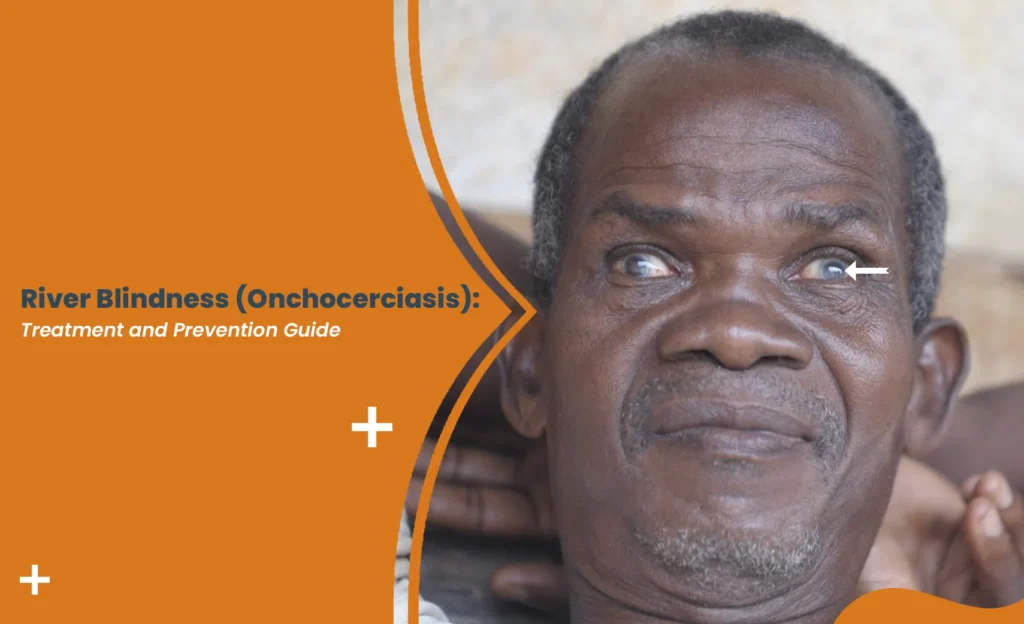
River blindness is one of those diseases most people in the U.S. or U.K. have technically heard of – but only in passing. A line in a documentary. A footnote in a global health article. Something that feels distant, abstract, safely “over there.”
But if you spend enough time reading about it – or talking to people who’ve worked in affected regions – it stops feeling abstract very quickly.
River blindness, or onchocerciasis, is not dramatic in the way outbreaks usually are. It doesn’t explode. It doesn’t announce itself. It just stays. Quietly. Patiently. Long enough to change skin, vision, livelihoods, and sometimes entire communities.
I remember speaking to a public health volunteer years ago who said, almost casually, “Some villages just moved away from the rivers.”
Not because the land wasn’t fertile.
Because the flies wouldn’t stop biting.
That’s where this story really begins.
Onchocerciasis Explained: How River Blindness Impacts Vision and Skin Over Time
River blindness is caused by a parasitic worm transmitted through the bite of blackflies that breed in fast-moving rivers and streams. These flies bite during the day – often multiple times – and each bite carries the risk of introducing microscopic larvae into the human body.
At first, the infection is subtle.
There’s itching. Persistent, maddening itching that doesn’t respond to creams or antihistamines. Skin becomes dry, thickened, prematurely aged. Some people develop small nodules where adult worms live under the skin, reproducing quietly for years.
And then, slowly, the eyes become involved.
Inflammation. Blurred vision. Light sensitivity. Gradual loss of sight.
Not overnight. Not suddenly. But steadily enough that people often don’t notice what they’re losing until it’s already gone.
Early Warning Signs of Vision Loss You Should Never Ignore
One of the cruelest aspects of river blindness is that blindness isn’t usually the first symptom people fear. Itching and skin changes come first. Social discomfort. Stigma.
By the time visual symptoms appear – persistent redness, blurred vision, difficulty seeing in bright light – the damage may already be underway.
This slow progression is why early intervention matters so much. Waiting until eyesight is affected is often waiting too long.
From Skin to Eyes: How Parasites Travel Inside the Human Body
The parasite responsible for river blindness doesn’t attack one organ in isolation. It moves. It migrates. It releases thousands of micro-offspring that trigger inflammation wherever they travel.
Skin. Eyes. Lymphatic tissue.
This isn’t unique to river blindness, either. Many parasitic infections behave this way, quietly affecting multiple systems at once – often mimicking other conditions and delaying diagnosis.
Parasitic Infections in Humans: Symptoms, Causes, and Treatment Options
If there’s one pattern parasitic diseases share, it’s unpredictability. Some people carry heavy infections with mild symptoms. Others react violently to relatively small parasite loads.
River blindness is no exception.
The disease thrives where healthcare access is limited, sanitation is poor, and repeated exposure to infected insects is unavoidable. And once established, it doesn’t simply burn out.
It persists.
Treatment Today: Where Ivernock 12 mg Fits In
For decades, river blindness was considered nearly impossible to control. Adult worms can live inside the human body for more than a decade, shielded from most medications.
The real breakthrough came with drugs that target the parasite’s offspring rather than the adults themselves.
That’s where Ivernock 12 mg plays a central role.
When taken correctly, Ivernock 12 mg reduces the number of microfilariae circulating in the body. Fewer microfilariae mean less inflammation, reduced skin damage, and—most importantly – lower risk of eye complications.
It doesn’t cure the disease overnight. And it doesn’t kill adult worms instantly.
Instead, Ivernock 12 mg works slowly over time to break the transmission cycle and stop the disease from getting worse when taken regularly.
How Ivermectin Works Against Parasitic Infections (Explained Simply)
Think of the parasite lifecycle like a factory. Adult worms are the machines. Microfilariae are the products rolling off the line.
Ivernock 12 mg shuts down production.
Without new larvae circulating in the bloodstream, inflammation subsides. Transmission slows. Communities begin to see real change – sometimes within a few years.
But only if treatment continues.
Ivermectin Dosage Basics: What Doctors Consider Before Prescribing
Dosing isn’t guesswork. It’s calculated based on body weight, exposure risk, and local transmission patterns.
In mass drug administration programs, Ivernock 12 mg is often given once or twice yearly for many consecutive years. This long-term consistency is what makes elimination possible.
Skipping doses weakens the entire effort.
Ivermectin Side Effects: What’s Normal and When to Be Concerned
Most side effects linked to Ivernock 12 mg aren’t caused by the drug itself, but by the immune system reacting to dying parasites.
Headache. Fatigue. Mild fever. Temporary dizziness.
In well-run programs, people are warned ahead of time so they don’t panic – or abandon treatment after the first dose.
Trust matters more than pills.
Why Self-Treating Parasitic Infections Can Backfire
One recurring issue in both endemic and non-endemic regions is self-medication. People hear about ivermectin, obtain it without proper guidance, and take incorrect doses – or take it for the wrong condition entirely.
This not only reduces effectiveness but increases the risk of side effects and treatment failure.
River blindness is not a one-time pill problem. It’s a long game.
Understanding Disabilities Caused by Neglected Tropical Diseases
Blindness isn’t the only disability linked to river blindness. Chronic skin disease makes it hard to move around, work, and stay mentally healthy. Communities that have the disease often have problems with their economies for many years.
That’s why getting rid of river blindness isn’t just about fixing bad eyesight; it’s also about giving people back their dignity, productivity, and opportunities.
Lymphatic Filariasis and Other Related Tropical Diseases
River blindness often exists alongside other parasitic diseases like lymphatic filariasis and strongyloidiasis. These infections are geographically and socially overlapping, making health problems worse for people who are already at risk.
The best results have come from integrated treatment programs that work on more than one parasite at a time.
Why Prevention Matters More Than Treatment in Parasitic Diseases
Medication alone doesn’t eliminate river blindness.
Reducing exposure to blackflies through vector control, protective clothing, and environmental management remains essential. Education is equally important – people are far more likely to participate in treatment programs when they understand why they matter.
Can You Get the Same Parasitic Infection Again?
Unfortunately, yes.
Even after successful treatment with Ivernock 12 mg, reinfection is possible if exposure continues and community-wide efforts break down. This is why elimination depends on collective participation, not individual treatment alone.
A Personal Reflection From the Field
One thing I’ve noticed after years of writing about global health is how invisible slow diseases are. If something doesn’t spread fast or kill loudly, it struggles to hold attention.
River blindness doesn’t shout.
It whispers.
And because of that, it’s been ignored far longer than it should have been.
Yet the tools to control it already exist. Used correctly and consistently, Ivernock 12 mg has helped whole areas get back land, jobs, and futures that were thought to be lost.
That’s not optimism. That’s evidence.
Final Thoughts
River blindness is no longer the unstoppable force it once was – but it isn’t gone yet.
With sustained access to Ivernock 12 mg, thoughtful prevention strategies, and continued public health commitment, onchocerciasis can remain on its current path: shrinking, retreating, becoming a memory rather than a destiny.
Quiet victories rarely make headlines.
But they change lives all the same.
FAQs
1. Is river blindness contagious from person to person?
No, and a lot of people get this wrong. You can’t get river blindness by touching someone, sharing food, or living in the same house. The parasite only spreads when infected blackflies that breed near fast-moving rivers bite you over and over again. Without the fly, the chain of transmission simply breaks. That’s why geography matters so much with this disease.
2. How long does it take for river blindness symptoms to appear?
That’s part of what makes the disease so difficult to catch early. Symptoms don’t show up right away. It can take months – or even years – after infection for noticeable signs like intense itching or skin changes to appear. Vision problems usually come much later. By the time eyesight is affected, the infection has often been present for a long time.
3. Does ivermectin actually cure river blindness?
This is where expectations need a reset. Ivermectin doesn’t kill the infection right away. Instead, it stops the parasite from making new larvae, which stops more damage to the skin and eyes. Taking it regularly for a few years can stop disease from getting worse and lower the number of people who get it in whole communities. Think about stopping and controlling, not a single dose cure.
4. Why do people need to take treatment repeatedly for years?
Because the adult worms are stubborn. They can live inside the body for a decade or more, quietly producing larvae. Repeated treatment keeps those larvae suppressed until the adult worms eventually die off naturally. Skipping doses gives the parasite an opening to recover, which is why consistency matters more than speed.
5. Is river blindness still a problem today, or is it mostly something that happened a long time ago?
It’s both. Long-term treatment programs have almost gotten rid of river blindness in some areas. In some places, it’s still a very real threat, especially in remote areas where healthcare is hard to get to. There is real progress, but it is not steady. The disease is still there; it’s just quieter now, which can be just as dangerous if people stop paying attention.