
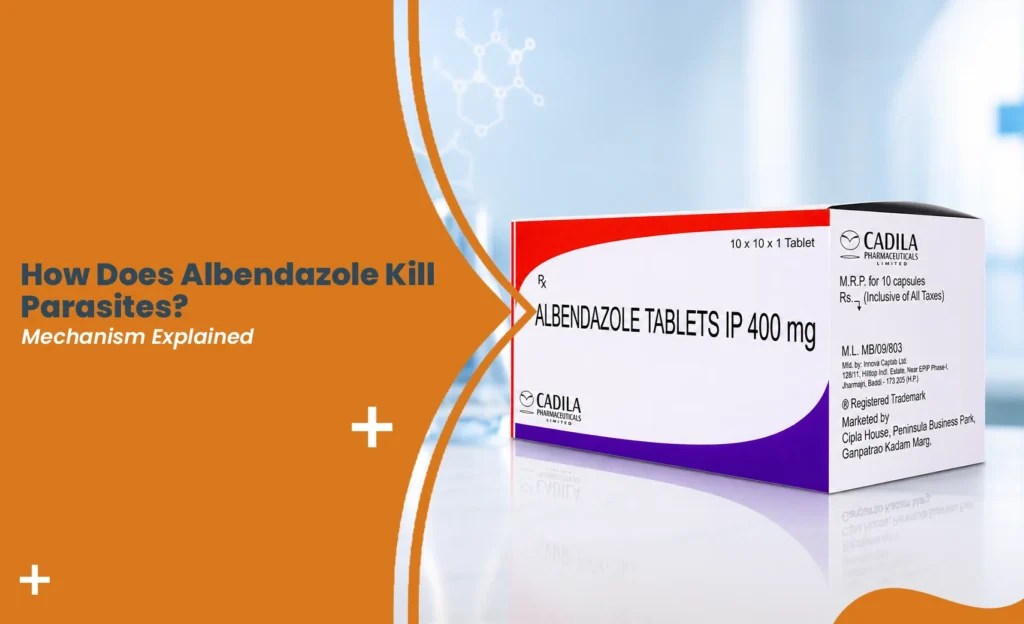
Parasitic worm infections are some of the most common neglected health issues on the planet, with an estimated 1.5 billion people worldwide affected. Few drugs are as widely used to combat them as albendazole, a broad-spectrum medicine on the World Health Organization’s List of Essential Medicines. But how does albendazole kill parasites on a cellular level? The answer is a well-understood, precise mechanism that targets a structure that every parasite cell needs to survive: the microtubule.
This blog explains in detail albendazole’s mechanism of action against parasites, how albendazole damages parasite cells, and the success rates in the real world behind the Albendazole 400 mg Tablet, one of the world’s most widely prescribed formulations.
Albendazole: What is it?
Albendazole belongs to the benzimidazole carbamates, a class of anti-parasitic agents renowned for their activity against parasitic worms (helminths). It is used to treat a variety of infections that happen due to larvae of tapeworms (e.g., ascariasis, hookworm, trichuriasis, strongyloidiasis, neurocysticercosis, and hydatid disease [e.g., echinococcosis]). Approved for use in the United States in 1996, it has since become a mainstay of mass deworming programs in areas where soil-transmitted helminth infections are common.
Albendazole Mode of Action Explained: The Microtubule Target
Microtubules are a basic concept in cell biology. This will help you understand in simple terms how albendazole kills parasites. Microtubules are threadlike protein structures that are part of the cell’s internal skeleton (the cytoskeleton). Microtubules are essential for parasitic worms because they help the worm maintain its cell shape, move nutrients around inside cells, and are needed to take in glucose from the worm’s surroundings.
The main target of albendazole is beta-tubulin, a certain protein that makes these microtubules. Absorbed albendazole is converted in the liver to its active metabolite, albendazole sulfoxide. This is a major reason albendazole can attack the parasite while remaining relatively safe for the person taking it.
How Does Albendazole Kill Parasite Cells Step by Step
Binding to tubulin
The active drug metabolite binds selectively to beta-tubulin in the cells of the parasite.
Polymerization by block
Binding keeps tubulin subunits from forming functional microtubules, which means the worm’s cells can’t build or keep up their internal skeleton.
Failure of glucose uptake
Microtubules are directly involved in nutrient uptake, and their disruption severely impairs the ability of the parasite to take up glucose, its main energy source.
Energy exhaustion
Loss of cytoplasmic microtubules reduces glucose uptake and depletes glycogen stores, cutting off the parasite’s main fuel supply.
ATP collapse
Degenerative changes in the endoplasmic reticulum and mitochondria are seen in the worm’s cells, with impaired uptake of glycogen and glucose, leading to the release of lysosomal enzymes and a reduction in ATP production. The energy currency each cell needs to function.
Immobility and death
The parasite is immobilized and eventually dies because of the lower energy production.
How Does Albendazole Kill Worms in Practice?
Now analyze how does albendazole kill parasites by focusing on the mechanism of action of albendazole. Benzimidazoles (e.g., albendazole) act by selectively binding to the beta-tubulin of the parasitic worm, leading to immobilization and death. Once immobilized and non-viable, the worms are cleared from the body, generally via the digestive tract for intestinal parasites, or gradually broken down by the immune system for tissue-dwelling larvae, such as those responsible for hydatid disease or neurocysticercosis.
In particular, albendazole is the only approved anthelmintic that can cross the blood-brain barrier and has nematocidal activity and is used for infections that involve the central nervous system, such as neurocysticercosis.
Albendazole Parasite Treatment Mechanism vs. Other Anthelmintics
How does albendazole kill parasites? This is a treatment for parasites that binds to tubulin in a similar way to related drugs like mebendazole, but it is generally more effective in several infections due to better absorption and tissue penetration. Both drugs block glucose transport and deplete glycogen by the same basic mechanism, but clinical differences in cure rates appear to emerge based on the species of the parasite involved.
Success Rate of Albendazole: What the Data Shows
After the application of different concentrations of albendazole on the larvae stage, the lowest and highest mortality rates were observed at 50 and 250 μg/ml of the drug, respectively. The 50 μg/ml of albendazole results in a 57% mortality rate, while the 250 mg/l of the drug resulted in 93% (65 of 70) of the larval deaths. The concentration of albendazole that’s required to kill 99% of parasitic worms was 573 μg/ml, which is better compared to other antiparasitics that were studied in the test. This figure showed that the larval mortality rate increased with an increasing albendazole concentration.
Ascariasis (roundworm)
Albendazole 400 mg’s single dose is very effective against this parasite. One trial reported a 100% cure rate of Ascaris on day 14 and day 21 post-treatment at multiple levels of doses. Similarly, another study reported a cure rate of 95.3% for ascariasis post a single dose.
Hookworm
How does albendazole kill parasites like hookworm? The answer is good but has more variable results. Early trial data showed cure rates of approximately 98% to 100% for hookworm at day 14, but a larger community-based study showed a slightly lower overall cure rate of 71.5% for related soil-transmitted helminths after mass drug administration, illustrating how real-world, community-level results can differ from tightly controlled clinical trials.
Trichuriasis (whipworm)
Now the question is how albendazole works in the body. This is where single-dose albendazole 400 mg is least effective. Cure rates in different trials have ranged from about 31% to 57% depending on the dose, and other studies have found overall community cure rates as low as 10%, underscoring why multi-day regimens or combination therapy is often used for whipworm infections.
Combination and repeat dosing
Repeated or combination dosing greatly improves outcomes for harder-to-treat infections. A single dose achieved an 85% cure rate for Ascaris in one controlled trial, while two doses were required to attain a 92% cure rate for hookworm.
When we look at the market value of albendazole, it’s valued at a pretty high rate globally. This figure shows that the global albendazole market size reached $1302 million in 2025. Its CAGR reached 5.302% in 2025. The albendazole market earned $477.11 million in Asia-Pacific regions. It is highest.
Why the Mechanism Matters for Treatment Decisions
How albendazole 400 mg works biologically is not just an academic exercise. It explains many practical aspects of the application of the drug. Albendazole has to be absorbed and metabolized to be active, so its absorption is increased four to five times when taken with a fatty meal, and this is why healthcare providers often recommend taking it with food. It also explains why the drug needs time to work, rather than killing the parasites immediately. The energy-depletion process described above happens gradually as glycogen reserves dwindle, not the moment the drug is swallowed.
Final Thoughts
Albendazole works by targeting a structure that parasitic worms cannot live without and that is known well: the microtubule. How does albendazole kill parasites? Albendazole blocks the absorption of glucose for the parasites. Thus, they do not get energy from hosts’ bodies and die. Nonetheless, one should adhere to the recommended dosage and consider possible side effects and interactions.
FAQs
1. What is the mode of mechanism of albendazole 400 mg in killing parasites?
Albendazole 400 mg binds worms’ beta tubulin. This medicine blocks microtubule assembly. This also discontinues glucose uptake. Thus, this depletes cellular energy.
2. How long does albendazole take to kill parasites?
Albendazole is not fast-acting. Its mode of action gradually depletes the parasite’s energy reserves, so effects are usually seen over several days, and a cure is confirmed by follow-up stool testing some two to four weeks after treatment.
3. Why does albendazole work better on some parasites compared to others?
Albendazole crosses the blood-brain barrier. It works systemically to penetrate deep tissue cysts.
4. Can you safely take albendazole regularly or repeatedly?
Albendazole is generally well tolerated in standard courses, but not for casual or repeated self-directed use. It has specific warnings, including the avoidance of pregnancy, and periodic monitoring of liver enzymes is recommended during prolonged courses. It must always be used under medical supervision.
5. What are the causes of a disruption of the cell division cycle at metaphase in tapeworm larvae and some nematodes?
The cells of the parasite can’t divide properly either, or it adds an inability to reproduce at the cellular level to the damage from energy loss.